
Archive Record
Images
Metadata
Object Name |
Letter |
Title |
Thomas Collins Letter |
Catalog Number |
TRE2006.002.2547 |
Scope & Content |
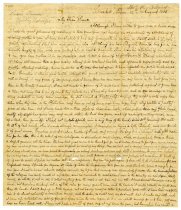
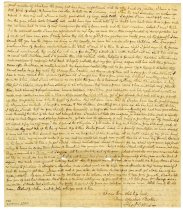
Letter from Thomas Collins to his sister. Collins is writing from Crocket Texas in August 1865. The letter explains to his situation the happenings of his house and land since emancipation that year. Most of his slaves are willing to stay until Christmas but believes that most will then strike out on their own. Collins believes that they are comfortable now but will soon realize the price that freedom from their "yankee friends" is high. Letter also shows that Texas surivived the war relatively okay. Collins is rather well off compared to many in the South. However, his financial holdings cause him to "be ruined." He is finding it hard to get paid by his debtors for the loss of slaves and cotton. Portions transcribed in 2019: Tho's. (Thomas) P. Collins Crockett, Texas, 14th August 1865 "I have six horses and ponies, and as our carriage is very strong, and still in very good condition, they [daughters] sail around in it extensively, saying, they might as well enjoy themselves when they can, as the Philistines may turn us out of house and home before long…" "Still I must say, the war has ruined me, or very near it, when it commenced. I must have been worth $100,000, or nearly so, now perhaps more than the tenth of it, if even so much. I paid my [?] to the Confederacy, they must be paid again if I am able to do it; including $11,000 of Confederate money I paid for Negroes. 37 bales of cotton the Confederacy took from me, and the notes, bonds, & receipts for new issue I had on hand when the collapse occurred, my loss in that currency was upwards of $100,000. Then the emancipation of the Negroes has nearly ruined all my debtors, some we considered the most solvent men in the country are now, I fear, totally ruined, so whether I will be able to collect anything from them the week or not, only time will tell. I have several thousand acres of land, but that, I am thinking, will be of little value for many years to come, and the taxes on it would probably be more than the land." [He continues about being poorer, and there being no credit to be had under the circumstances, yet they are doing okay.] "I can scarcely tell you how the Negroes are doing in this Country, we have ten adults and four children. When Granger's [*] proclamation of freedom was published in this state, I read it to them the same night I first saw it. The former declared unanimously that they would live with us, a few days ago they entered into a written contract with me, was to live with me as usual until Christmas, and I to provide them with victuals, clothes, lodging, & furnish them with the medical attendance and medicine if necessary; but I think it highly probable that very few, if any, negroes will live with their former owner after Christmas, no matter how well they have been treated. They will be going off & trying to do better. They cannot realise [sic] being free until they change their location, but thousands of them will be sorry for it when too late. I have a man named [Silus], upwards of 50 years old, I bought him three or four years ago. I intrust [sic] everything about the farm to him (I have not been in my corn field this year) he is husband to Penny , whom I purchased in July 1853… they have a frame house to live in, shingle roof, plank floor, brick chimney, & glazed windows, have a bedstead, mosquito [net], and good bedding, etc., and live nearly about as well as we do, and neither of them has even had a blow or a stripe since they lived with us, yet I feel assured that both will be giving up their comfortable home to try the sweets of freedom. They will soon learn that the Yankees have been the greatest enemies the Negroes have ever had." "Mary's mulatto girl Lucy I bought for her about eight years ago is not willing to leave her on any terms I believe, & Emmeline's two younger ones Betty & Addie, I think will probably remain, but Ann Eliza is married to a tanner, and I suppose, will leave about the end of the year. Indeed, I wish she was gone now, and do not like her much, she has too much jaw! I do not know how I am to make a living unless John […] can make arrangements with my creditors where to furnish me with the goods, so as to enable me to pay them; I have no money to purchase in Houston or elsewhere, and indeed goods are too high now in Houston to buy many even if I had the money to get them. " Ends with other family news and goodbyes - sweets is actually underlined in the letter, as sarcasm probably * - Gordon Granger (November 6, 1821 - January 10, 1876) was a career U.S. Army officer and a Union general during the American Civil War. When the war ended, Granger was given command of the District of Texas. On June 19, 1865 in the city of Galveston, one of the first orders of business was to read to the people of Texas Granger's General Order No. 3, freeing all slaves. This set off joyous demonstrations by freedmen and originating the annual Juneteenth celebration, which commemorates the abolition of slavery in Texas. ( Some small holes in the paper lead to question marks in transcription ) |
Date |
August 1865 |
Dates of Creation |
Augusst 1865 |
Event |
Civil War, U.S. |
People |
Collins, Thomas |
Search Terms |
Texas former slaves |
Subjects |
Reconstruction Plantations Tenancy Tenant & landlord Emancipation Workers Laborers Free African Americans Freedmen |